
Laser Cutting Machine Tube
Intricate and precise, Marshall Manufacturing’s CNC laser cutting machine tube capabilities are built for medical device components and implantables that demand the highest standards in accuracy and repeatability.
Our laser tube cutting machines can hold extremely tight tolerances, making them ideal for medium- to high-volume production runs. Whether producing surgical instruments, hypo-tubes, or complex component assemblies, our process ensures consistent, reliable results.
Get A Quote For Your Project
Precision Laser Tube Machining for Medical Applications
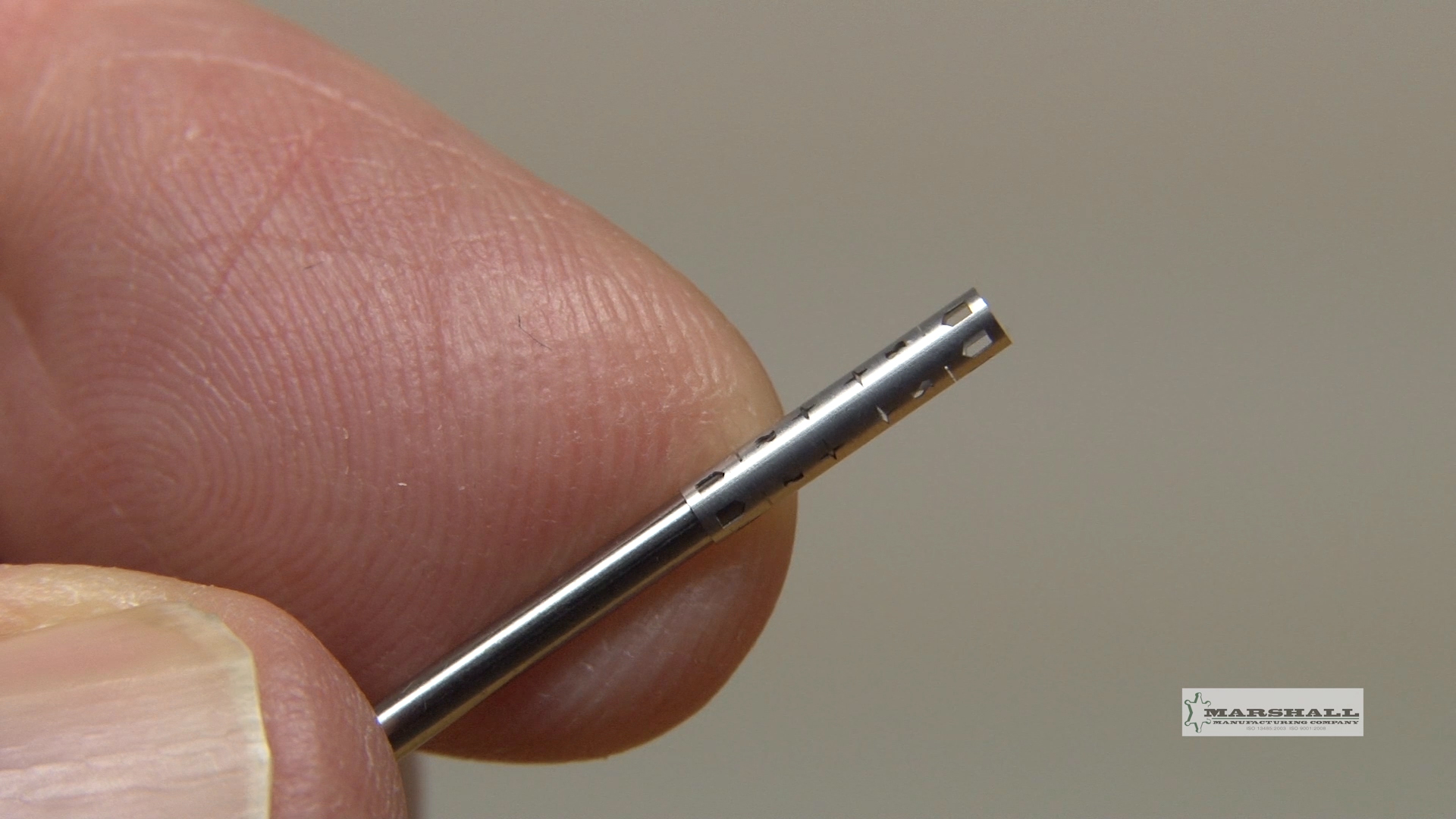
One of Marshall’s core competencies is CNC laser tube machining for medical hypo-tube and other small-diameter tubing applications.
Laser tube cutting excels in creating intricate features—such as holes, slots, and custom contours—in thin-walled tubing. This capability allows us to manufacture small surgical instruments and other precision devices with dimensional tolerances as tight as +/– .013 mm (+/– .0005″).
We can accommodate tube diameters ranging from 0.5 mm to 8 mm (.020″ to .315″), with maximum wall thicknesses around 0.5 mm (.020″) for most materials.
Our Laser Tube Machining Process
Marshall’s equipment includes 2 + 2 axis CNC laser tube cutting systems:
Primary 2 axes control tube rotation and axial movement.
Additional 2 axes allow side-to-side and vertical motion for more complex geometries.
These multi-axis capabilities enable:
Complex pattern generation
Bevel and trapezoid cuts
Off-center rectangle features
Multi-hole and slot configurations
Marshall utilizes two advanced laser technologies:
Fiber laser technology: valued for its efficiency, precision, and versatility. It is compatible with a wide range of materials, including stainless steel, titanium, cobalt-chrome, and select polymers.
Femtosecond laser technology: designed for ultra-precise cutting with minimal heat-affected zones (HAZ). Because the metal is vaporized rather than melted, this process reduces recast and oxide discoloration. As a result, it significantly decreases the need for post-process cleaning steps such as pickling and electropolishing.
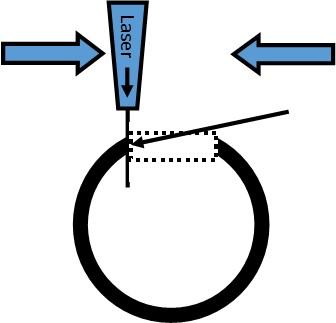
2+2 Axis Diagram:
When Y-Axis is utilized and the tube is not rotated, the laser beam cuts an off-center rectangle through the wall of a tube—and a vertical cut is produced on the longitudinal edge of the cut.
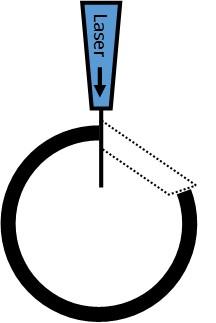
3 Axis Diagram:
When there isn’t an active Y-Axis and the tube is rotated—and the laser beam is directed towards the center of the part when cutting a rectangle through the wall of a tube—a bevel (trapezoid) is produced on the longitudinal edge of the cut.
How Laser Tube Machining Improves Product Reliability
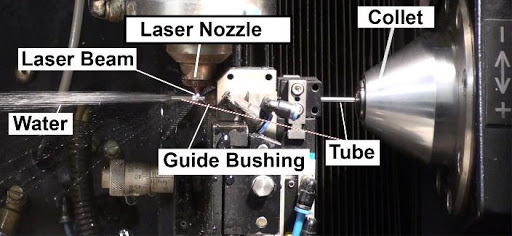
By focusing the laser beam with precision and using stable guide bushing and collet systems, we minimize heat-affected zones, prevent slag buildup, and ensure smooth, burr-free edges.
In certain applications, water is introduced during cutting to flush debris, eliminate slag on opposite walls, and protect part surfaces—resulting in clean, ready-to-use components.
FAQ: Laser Cutting Machine Tube for Medical Device Manufacturing
What components are best suited for laser tube machining?
Medical hypo-tubes, surgical instruments, implantable devices, and tubing with intricate hole or slot patterns.
What sizes can you accommodate?
Tube diameters from 0.5 mm to 8 mm with wall thicknesses up to 0.5 mm, depending on material.
Can you handle prototype and production quantities?
Yes, we support both small-batch prototyping and high-volume manufacturing runs.
Why Medical Device Manufacturers Choose Marshall
- Tight Tolerances: Down to ±.0005″ for critical medical applications
- Material Flexibility: Compatible with medical-grade metals and select polymers
- Efficient Processing: Many parts are production-ready without secondary operations
- Industry Standards: All manufacturing adheres to ISO and FDA medical guidelines
Related Manufacturing Capabilities
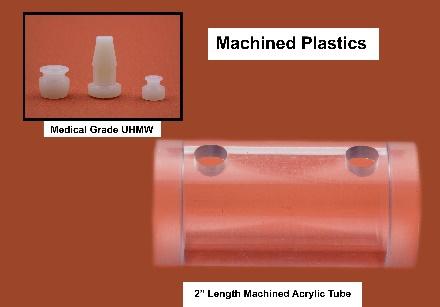
Machining Plastics
We machine components for several filtration companies, utilizing a multitude of plastic materials in a variety of diameters and lengths.
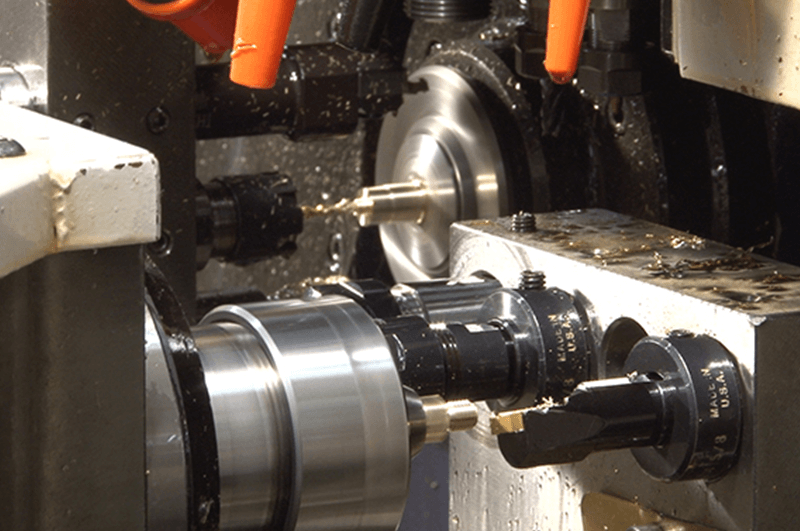
Swiss Machining
Swiss machine are capable of multiple operations, including; turning, milling, drilling, threading and additional operations.
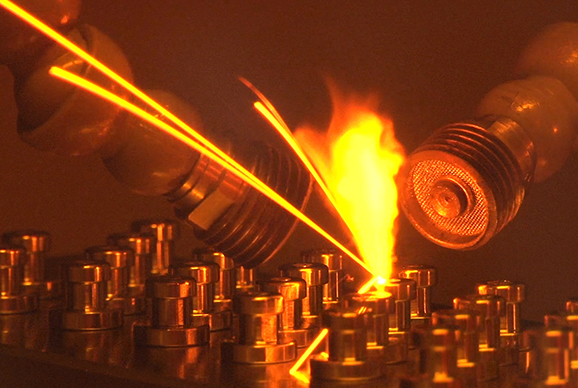
Laser Welding
CNC Laser Welding is one of many methods Marshall uses for the assembly of components within medical device manufacturing.
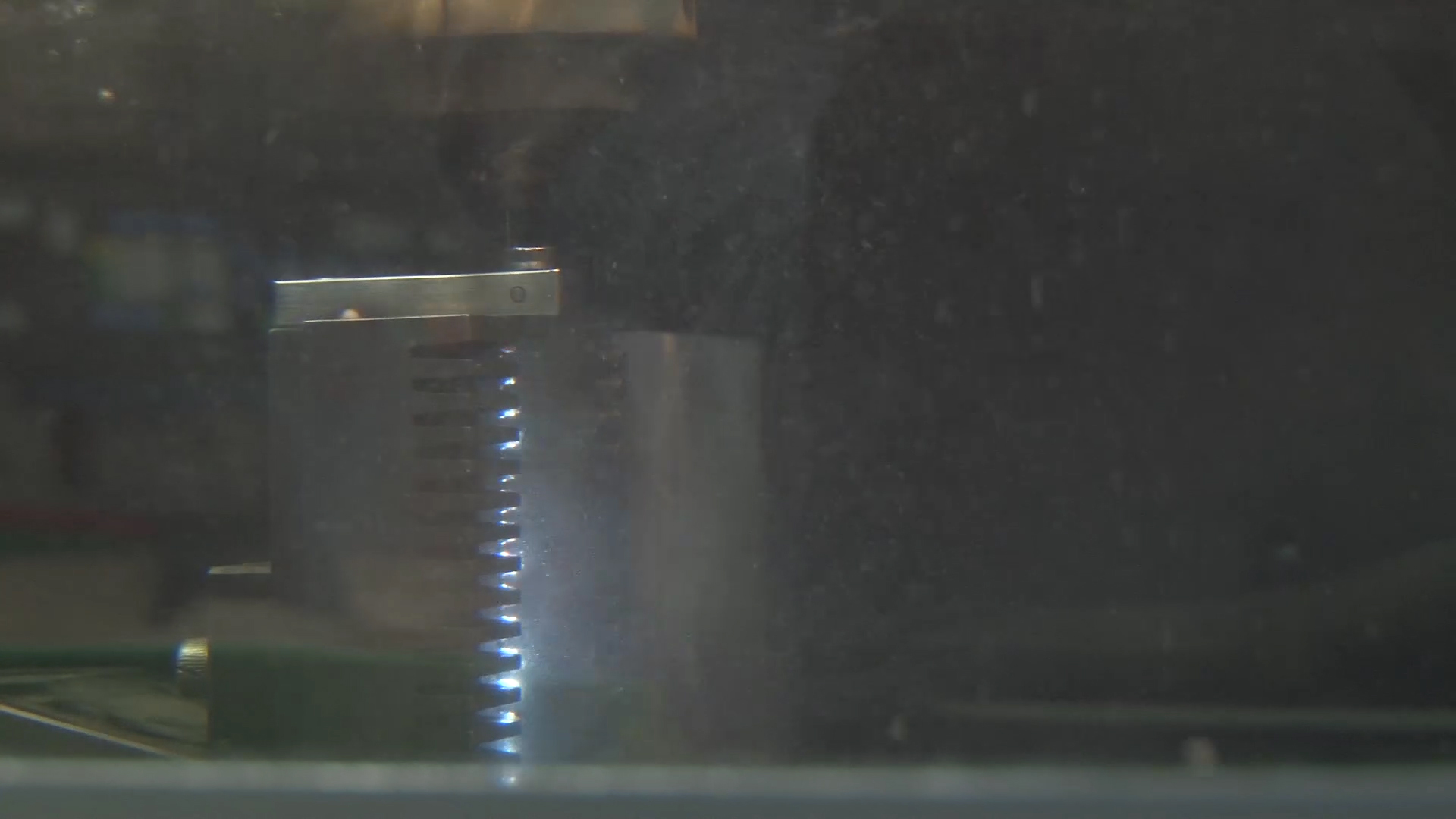
Wire EDM
Within Medical Device Manufacturing, Wire EDM is often utilized for cutting slots and grooves in multiple stacked parts.
Tuning and Milling
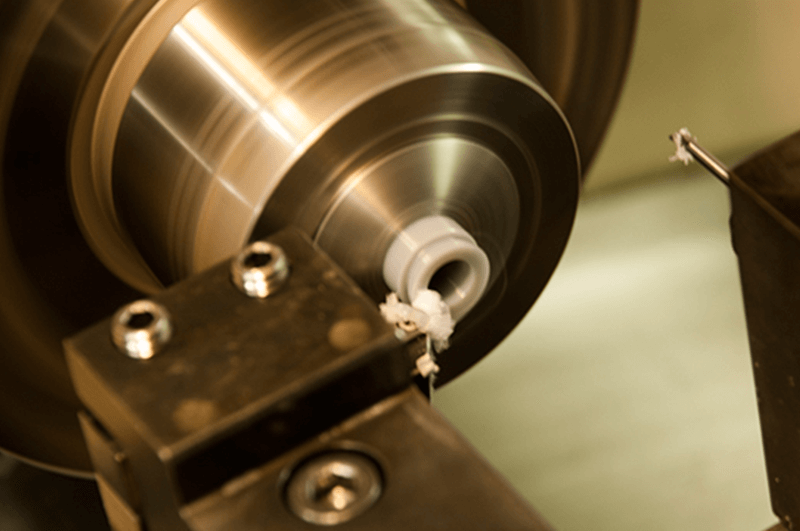
CNC Turning and CNC Milling are typically dedicated to toolmaking, which is part of Marshall’s total capability set.
Medical Assembly
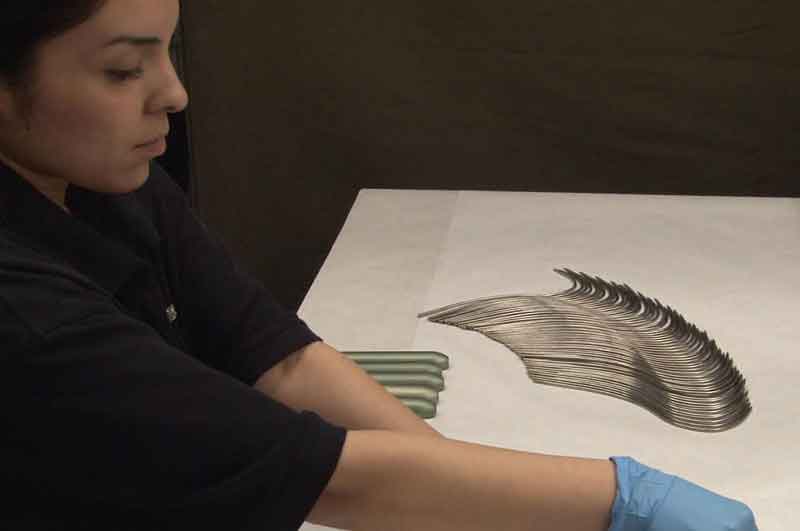
Marshall employs a variety of methods for the assembly of components, including CNC laser welding, press fitting and epoxy.